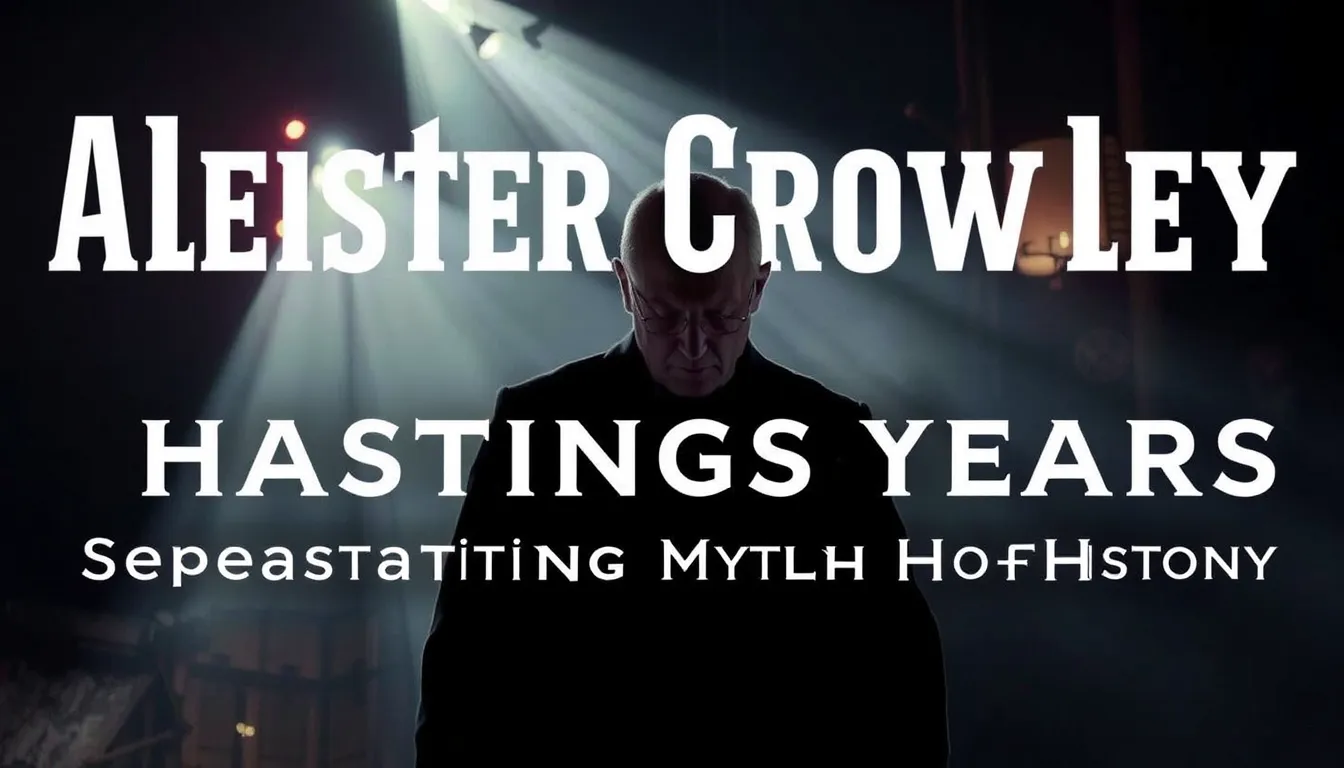
Aleister Crowley’s Hastings Years: Separating Myth from Local History
Crowley’s Final Chapter in Hastings
Most people who know the name Aleister Crowley associate it with scandal, rumour and the sensational headlines of his lifetime. Yet the man who styled himself the Great Beast spent his last years not in some far-off capital but here in Hastings, where he settled towards the end of the Second World War. For anyone who walks the seafront or wanders through the Old Town, that is a striking thought. He chose a quiet corner of East Sussex as his base, renting a room at Netherwood, a guesthouse on the outskirts of town that drew writers, philosophers and scientists. Rather than the destitute recluse of popular imagination, historians who have studied the house describe a man who walked the lanes, wrote letters and books, and received a steady stream of visitors. Room 13, the room he rented, has become a small piece of local lore. It is worth remembering that the Hastings of the 1940s was a town recovering from war, with its own rhythms and its own residents. Crowley was one more face among many, albeit a notable one, and his presence shows how much intellectual life once existed in the streets many of us still call home.

Surrey and Kent Roots Close to Home
The connections do not end at the Sussex coast. Crowley grew up in Redhill, Surrey, in a household shaped by strict evangelical faith, and later wrote fondly of those childhood years as a time of real contentment. Redhill and the surrounding Surrey towns are close enough that many readers in the wider area will know the streets and landmarks he would have passed. He also spent a brief and unhappy period at Tonbridge School in Kent, an experience that some accounts suggest helped shape his later disdain for Victorian convention. Local historians and biographers, including writers such as Antony Clayton and Gary Lachman, have traced these routes through the south east, offering residents a chance to see the region as part of a longer story. For those interested in local heritage, this is a reminder that the buildings and schools around us often carry stories far beyond their own walls. Anyone exploring old family homes, period houses or character properties in the area may find that research like this sparks interest in the history of their own street, whether that means checking deeds, old maps or the original design of a house before planning work such as a loft conversion.
What Residents Can Do Next
So what should local people take from all this? First, it is worth approaching the Crowley legend with a healthy scepticism. Much of his reputation was built by critics and admirers alike, and his influence on later culture, from rock musicians to counterculture writers, is well documented. Second, the Hastings chapter offers a genuine local hook. Residents interested in the area’s history can visit local libraries and archives, which hold material on the town’s twentieth century residents, or join community heritage walks when they run. Keep an eye out for any new commemorations, plaques or talks that may be announced as interest in his life continues to grow. For homeowners in older properties, the story is a useful reminder to plan work carefully. Many period houses across Hastings and Surrey have been adapted over the years, and projects such as loft rebuilding or loft refurbishment should be checked against local planning rules, especially in conservation areas. Speaking to experienced local tradespeople, including Guildford builders who regularly work on heritage properties, can help ensure that improvements respect the character of the buildings we all share.
Source: Aleister Crowley: Was he the ‘world’s wickedest man’?